Patient engagement is no longer questioned in principle. Across pharma it has become an expected part of developing medicines, designing clinical trials and improving patient support.
The challenge is no longer whether to engage patients. It is proving the value that engagement creates.
Patient engagement leaders are increasingly being asked the same questions:
- Did patient engagement influence important decisions?
- Did it reduce uncertainty or risk?
- Did it improve outcomes for patients or the organisation?
- How do we demonstrate a return on investment?
These are reasonable questions, but they are often framed in the wrong way.
The difficulty is that patient engagement rarely acts in isolation. Decisions are shaped by scientific evidence, clinical expertise, regulatory requirements and commercial priorities. Therefore, expecting patient engagement to demonstrate direct causation sets an impossible standard.
The better question is not “did patient engagement cause this outcome?”, but instead “can we demonstrate how patient engagement contributed to better decisions that ultimately influenced outcomes?”
The shift from proving causation to demonstrating contribution is the key to measuring patient engagement effectively.
The Problem with Current Measurement
Many organisations measure what is easiest to capture:
- Number of patients engaged
- Activities completed
- Insights collected
- Satisfaction scores
These metrics remain important as they demonstrate that engagement took place and was delivered well, but they struggle to answer the real question leadership asks which is “what changed because of it?”.
To demonstrate value, organisations need to measure the journey from patient voice to impact, rather than whether the engagement activity occurred.
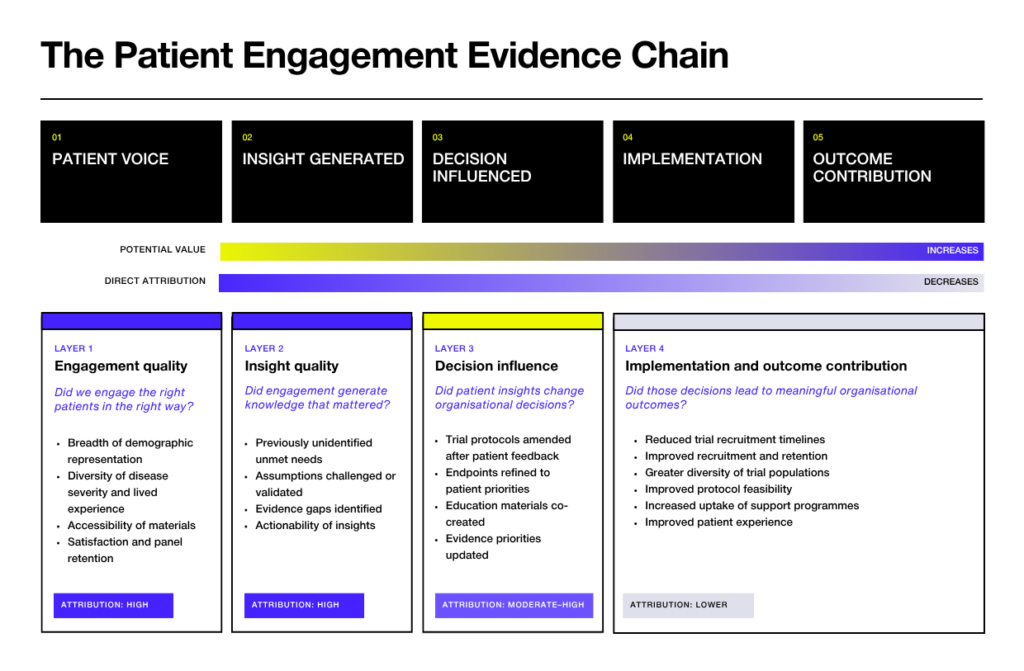
The Patient Engagement Evidence Chain
Rather than searching for a single measure of ROI, organisations should build evidence across the entire pathway from engagement to outcomes.
As we move along this pathway potential value increases, but measurement becomes more challenging and direct attribution starts to decrease. Therefore, rather than focusing only on what can be directly attributed, organisations should build evidence at every stage of the pathway.
Engagement Quality sets the foundation: without representativeness, inclusivity, and accessibility, engagement delivers little of value. Insights fall short.
Insight Quality determines if patient engagement has surfaced actionable perspectives that standard approaches miss.
Decision Influence marks the shift from data collection to driving change.
Implementation and Outcome Contribution is where leadership naturally concentrates, yet it also complicates attribution.
While these outcomes are critically important, they are rarely achieved solely through patient engagement.
The goal here is not to claim that patient engagement caused these outcomes, but to demonstrate a credible chain of evidence showing how patient insights informed decisions that contributed to better outcomes.
The Missing Step: Define Value Before Engagement Begins
The Patient Engagement Evidence Chain provides a practical way to measure contribution across the journey from patient insight to organisational outcomes.
However, there is one critical condition.
The chain only works if organisations know what they are trying to influence before engagement begins. Too often, teams engage patients first and then ask afterwards, “What value did this create?” By that stage, the evidence chain has already been broken. While Layers 1 and 2 can still be measured, demonstrating decision influence and outcome contribution often becomes little more than informed guesswork.
A stronger approach is to define a Patient Engagement Value Hypothesis before engaging patients.
Before any activity begins, ask:
- What decision are we trying to improve?
- What uncertainty are we trying to reduce?
- What evidence do we need from patients?
- What could realistically change because of what we learn?
- What would be the expected impact of this change?
By answering these questions upfront, measurement becomes part of the engagement design. Rather than retrospective reporting, organisations create a prospective plan for demonstrating value.
Measuring Contribution, Not Claiming Causation
The purpose of patient engagement measurement is not to prove that a single patient conversation created a business outcome.
It is to build a credible chain of evidence.
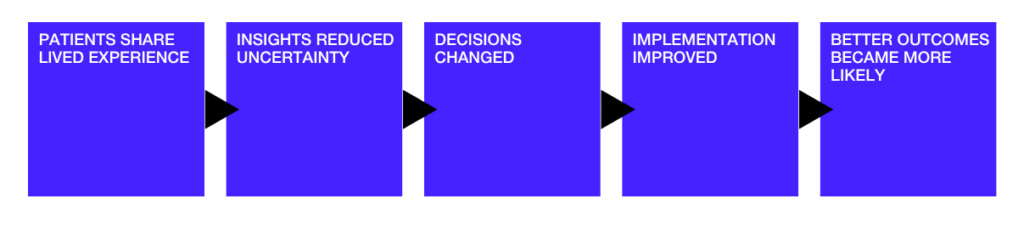
This is how organisations evaluate value in every complex decision-making environment, and therefore patient engagement should be no different.
Looking Ahead
The question is no longer “how many patients did we engage?”, but instead “what did we learn, what changed because of it, and what value did that create?”
Patient engagement creates value when patient perspectives move beyond conversation and shape the decisions organisations make. By building a chain of evidence, organisations will be much better placed to demonstrate why patient engagement matters and how it shifts the needle.
If you’d like to discuss how Impatient Consulting can help your business answer it’s toughest questions, let’s talk!